

Floor puzzles for kids are a simple and engaging family activity that supports early learning through play. With their large pieces and colourful illustrations, they are especially appealing to young children who enjoy exploring and building on the floor.
Unlike smaller table puzzles, floor puzzles create an open play space where children can move around, experiment with pieces, and work together with parents or siblings. This type of shared play encourages problem solving, communication, and cooperation while still feeling fun and relaxed.
Many simple family activities help children learn while spending time together, and floor puzzles are one of the easiest ways to combine playtime with early development.
Table of Contents
Why floor puzzles for kids are perfect for family playtime
Floor puzzles are designed specifically with younger children in mind. The pieces are larger, the images are clear and engaging, and the puzzle itself spreads across a wide space on the floor.
This layout allows children to interact with the puzzle in a more physical way than traditional puzzles.
Children often move around the puzzle as they play. They may crawl, stretch, or walk around it to find pieces or see how the picture is forming. This type of active engagement keeps children interested while also supporting early development.
Floor puzzles for kids also naturally encourage parents or siblings to join in, turning puzzle time into a shared activity rather than a solitary task. Activities like puzzles and construction toys help children explore shapes, patterns, and spatial relationships. You can read more about how building blocks support child development in our related guide.
Supporting problem-solving and thinking skills
Every puzzle presents children with a small challenge: figuring out where each piece belongs. As children experiment with pieces, they begin to recognise patterns, shapes, and visual connections. At first, children often rely on trial and error. Over time they begin to develop simple strategies.
Children may start to:
• Look for edge pieces first
• Group pieces by colour or image
• Turn pieces around to see if they fit differently
• Focus on completing one small section of the puzzle
Activities like floor puzzles encourage children to explore shapes, patterns, and spatial relationships while they play. According to the National Association for the Education of Young Children, play is a key part of early development and helps children build important cognitive and social skills.
Strengthening fine motor skills and coordination
Handling puzzle pieces requires precise movements. Children must pick up pieces, rotate them, and carefully place them into the correct position.
These small actions help develop:
• Fine motor control in the hands and fingers
• Hand–eye coordination
• Spatial awareness
As children practise these skills through play, they are also building abilities that support everyday tasks such as drawing, writing, and using utensils.
Social and emotional benefits of puzzle play
Puzzle play is often more than just a cognitive activity. When children work on puzzles with parents, siblings, or friends, they also practise social and emotional skills. Shared puzzle time creates opportunities for conversation, cooperation, and teamwork.
Encouraging communication during play
Floor puzzles fir kids naturally encourage discussion during playtime. Parents and children often talk about what they see in the puzzle image, describe colours or objects, or suggest where a piece might belong.
These conversations help children:
• Expand their vocabulary
• Practise expressing ideas
• Learn to listen and respond to others
Talking through a puzzle together also strengthens the connection between parent and child during play. Many toys help children develop communication and social skills through play. Activities like puzzles, pretend play, and doll play all support learning through interaction.
Helping children develop patience and focus
Unlike many fast-paced toys, puzzles encourage children to slow down and concentrate. Completing a puzzle takes time and attention. Children learn that progress happens piece by piece and that persistence helps them reach their goal.
Puzzle play helps children practise:
• Concentration and attention to detail
• Patience while working through a challenge
• The satisfaction of completing a task
These experiences help build confidence and resilience, both of which are important for learning.
Choosing the right floor puzzle for your child
Selecting the right puzzle can make a big difference in how enjoyable the activity is for children. A puzzle that matches a child’s age and ability level keeps the experience engaging without becoming frustrating. When choosing a floor puzzle, it helps to consider a few key factors:
Age and skill level
Younger children usually benefit from puzzles with fewer pieces and larger shapes that are easy to handle.
Familiar images
Children are often more motivated when puzzles include pictures they recognise, such as animals, vehicles, or favourite characters.
Durability
Because floor puzzles are used during active play, sturdy pieces made from thick cardboard or wood tend to last longer.
Gradual challenge
As children become more confident, puzzles with more pieces or slightly more detailed images provide the right level of challenge.
The goal is to find puzzles that encourage curiosity and exploration rather than frustration.
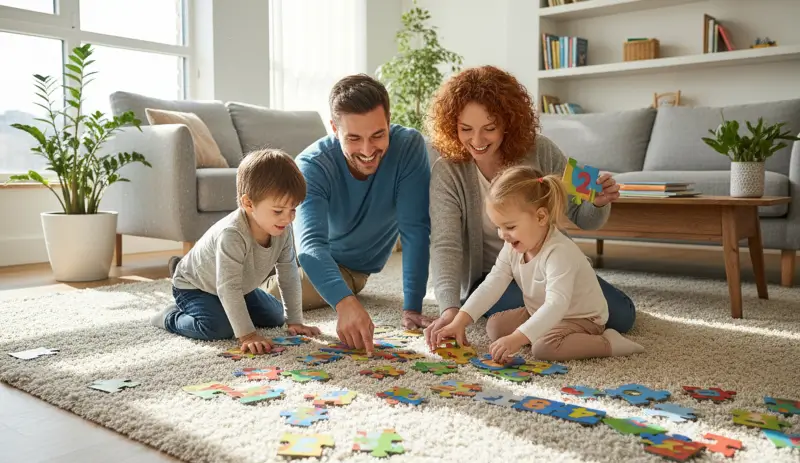
Making floor puzzles for kids part of family playtime
One of the best things about floor puzzles fir kids is how easy they are to include in everyday family routines.
A comfortable open space on the floor is usually all that is needed. Parents can sit nearby, help children find pieces, or simply talk about what they see in the puzzle picture.
Puzzle time does not need to be structured or rushed. Children may start a puzzle, take a break, and return to it later. The focus is on the experience of working together and enjoying the activity.
Over time, puzzles can become a regular part of family playtime that encourages both learning and connection.
Can children of different ages play floor puzzles together?
Yes, floor puzzles for kids are a great activity for children of different ages to enjoy together. Because the puzzle is spread across a larger space, several children can participate at the same time without feeling crowded.
Older children can often help guide younger ones by suggesting where pieces might fit or helping to organise pieces by colour or shape. Younger children may focus on placing larger or more obvious pieces while observing how older siblings approach the puzzle.
This kind of mixed-age play can support several positive experiences for children:
• Younger children learn by watching and copying older siblings
• Older children practise patience, leadership, and problem solving
• Siblings work toward a shared goal together
• Families create a relaxed moment of cooperative play
Activities like floor puzzles allow children to contribute at their own level while still participating in the same activity, making them a simple and enjoyable option for family playtime.
Floor puzzles for kids offer more than simple entertainment. They create opportunities for families to spend time together while supporting important early learning skills. As children work through puzzles, they practise problem solving, coordination, communication, and patience. When siblings of different ages join the activity, puzzle play becomes a shared experience where everyone can participate and learn at their own pace. In many ways, floor puzzles for kids show how everyday family activities can turn playtime into meaningful learning moments.



0 Comments