

Play is how children make sense of the world, and pretend play holds a special place within it. Through imagination, they rehearse situations, explore relationships, and process emotions in ways that shape learning and growth. It is often during these playful moments that children practise the skills they will later use in classrooms, friendships, and everyday challenges.
At Let’s Learn Kidz, we see pretend play as a pathway to creativity, communication, and confidence. t invites them to create, to share, and to learn in ways that are meaningful and lasting, and that is why it remains one of the most significant parts of childhood.
Table of Contents
What Is Pretend Play
Pretend play, also called imaginative or make-believe play, is when children act out scenarios beyond their immediate reality by imagining themselves, objects, or situations as something different from what they are. A stick might become a sword, a box might turn into a house, or a child might step into the role of a teacher or doctor. Through these scenarios, children explore roles, relationships, and environments that give them opportunities to practise skills and ideas they may not experience in everyday life.
Pretend Play vs Other Forms of Play
Different forms of play serve different purposes in child development. Pretend play stands alongside functional, constructive, and rule-based play, each with its own role in learning.
| Type of Play | Description | Examples | Developmental Benefits |
| Functional Play | Repeated actions that explore how objects work and feel. | Rolling a toy car, stacking blocks, shaking a rattle. | Builds motor coordination, sensory awareness, and an understanding of cause and effect. |
| Constructive Play | Using materials to build, arrange, or design something new. | Creating a tower from blocks, making a LEGO house, assembling puzzles. | Strengthens problem-solving, spatial reasoning, planning, and persistence. |
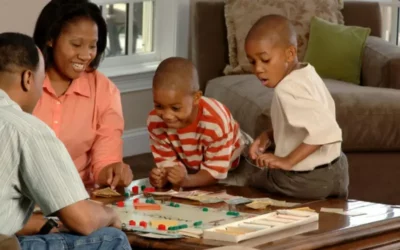
| Rule-Based Play | Games and activities guided by agreed rules or instructions. | Board games, card games, “Simon Says,” team sports. | Develops memory, logical thinking, fairness, cooperation, and self-control. |
| Pretend Play | Imagining roles, objects, or scenarios that represent something else. | Playing house, running a pretend shop, acting as superheroes, puppet theatre. | Encourages symbolic thinking, creativity, empathy, language skills, and social negotiation. |
The Developmental Stages of Pretend Play
Pretend play develops gradually, with each stage adding new layers of imagination, language, and social interaction. Children may progress at different speeds, but the overall pattern shows how play evolves from simple actions into complex, shared storylines.
Infancy
Even before true pretend play emerges, babies and young toddlers show early signs that pave the way for imagination. They copy gestures, mimic facial expressions, and imitate simple actions they see adults perform, such as pretending to stir with a spoon. These imitations are important because they mark the beginning of symbolic thought, the foundation on which pretend play rests.
Toddlers
By around two years old, children begin to use objects symbolically. A spoon becomes a phone, a block turns into food for a toy animal, or a doll is tucked into bed. At this stage, pretend play is usually solitary or parallel, with children playing near one another but not yet fully interacting. Developmentally, this period supports language growth, fine motor skills, and the first steps toward understanding that one thing can represent another.
Preschool Years
Preschoolers expand pretend play into longer, more coordinated storylines. They assign roles such as parent, firefighter, or teacher, and invite others to participate in shared scenarios. Play becomes social, requiring negotiation and compromise as children decide who will play which part and how the story will unfold. Everyday routines and experiences often appear in these games, such as cooking, shopping, or visiting the doctor. This stage strengthens cooperation, empathy, and emotional expression.
Primary Years
Older children begin to build entire imaginary worlds that follow consistent rules and include recurring characters. These games can last days or even weeks, often involving groups of peers who work together to sustain the narrative. Children at this stage are capable of weaving moral questions, friendship challenges, and complex problem-solving into their play. This supports reasoning skills, teamwork, and a growing awareness of fairness and justice.
Later Childhood
As children move into later childhood, pretend play often evolves into more structured role-playing activities. Drama, storytelling, and strategy games may replace earlier forms of make-believe, but the imaginative core remains. Children may design elaborate scenarios with rules, maps, or scripts, blending creativity with organisation. Digital role-play and online storytelling also become common, reflecting the shift toward more advanced social and cognitive skills while still rooted in the same imaginative foundations.
Cognitive Benefits of Pretend Play
Pretend play stimulates mental growth by exercising the skills that shape how children think, learn, and approach challenges. Research shows that imaginative role-play directly supports the development of imagination, language, and reasoning. These abilities become the foundation for later learning, preparing children for classroom tasks as well as problem-solving in daily life.
Imagination and Creativity
Imagination and creativity are a child’s ability to generate ideas, picture possibilities that are not directly present, and combine familiar elements in new ways. Pretend play strengthens these abilities through symbolic thinking. This is the cognitive skill that allows one object, action, or role to stand for something else. When a child uses a block as a car or pretends to be a doctor, they are practising the mental process of substitution, taking what is available in the real world and reworking it into something entirely new.
This process is important because it activates the same neural pathways involved in abstract reasoning, problem-solving, and innovation. By creating and sustaining imagined scenarios, children learn to shift perspectives, test out ideas, and build flexible mental representations.
For example, a cardboard box may become a pirate ship complete with a crew, treasure, and an imagined journey. In creating that world, the child is not only inventing a story but also rehearsing the ability to transform ordinary materials into meaningful symbols, which is the foundation of imaginative thought and creative expression.
Language Development
Language development is the growth of vocabulary, grammar, and communication skills that allow children to express ideas and understand others. Pretend play supports this growth because it naturally requires children to use and experiment with language. In role-based scenarios, they create dialogue, explain their actions, and assign meaning to roles or objects. These activities engage both expressive language, when they speak and narrate, and receptive language, when they listen and respond to peers.
As children take part in imaginative storylines, they practise sequencing, narrative building, and conversational turn-taking. They also refine pragmatic language, which is the social use of communication such as negotiating roles, clarifying misunderstandings, and adjusting tone to fit a character. These skills provide early preparation for reading comprehension, storytelling, and effective participation in group discussions at school.
For example, children running a pretend shop may assign themselves roles as shopkeeper and customer, decide what items are for sale, and negotiate prices. In doing so, they expand their vocabulary, practise sentence structure, and use language to solve problems and maintain social interaction.
Problem-Solving and Critical Thinking
Problem-solving and critical thinking involve identifying challenges, weighing options, and choosing strategies to reach a goal. Pretend play provides constant opportunities for children to practise these skills because imaginative scenarios rarely follow a fixed path. A story may stall, a disagreement about roles may arise, or an invented obstacle may need to be overcome. Each situation calls for decisions, adjustments, and cooperation.
Through these moments, children learn to evaluate different possibilities and consider the consequences of their choices. They practise flexible thinking by adapting when plans change and by inventing new solutions on the spot. Over time, these experiences strengthen reasoning, decision-making, and the ability to approach problems with persistence rather than frustration.
For example, a group of children pretending to be firefighters may decide how to “rescue” a toy animal from a tall shelf. They might test different methods, such as building a ladder from blocks or assigning one child to climb and another to catch. In solving this challenge, they are rehearsing real cognitive skills: planning, collaboration, and evaluating which approach works best.
Social and Emotional Benefits of Pretend Play
Pretend play strengthens the ways children relate to others and manage their feelings. Through role-based scenarios, they practise empathy, collaboration, and self-control in ways that translate directly into everyday interactions.
Empathy and Perspective-Taking
Empathy and perspective-taking involve recognising and considering the feelings, thoughts, and experiences of others. Pretend play supports these skills by allowing children to step into roles outside of their own lives. When a child pretends to be a doctor, a teacher, or even a superhero, they rehearse what it might be like to act and feel in those roles. This process expands their capacity to understand different viewpoints and builds early social awareness.
For example, a child pretending to care for a sick doll is not only copying behaviour they have seen but also practising the emotional response of concern and responsibility. These small acts of role assumption help children connect with the experiences of others in real life.
Cooperation and Teamwork
Cooperation and teamwork are the abilities to share tasks, coordinate with others, and reach a shared goal. Pretend play provides a natural context for these skills because group storylines cannot continue unless children work together. They must agree on roles, share materials, and adapt the story as it unfolds.
This kind of collaboration teaches children to listen, negotiate, and respect the ideas of their peers. It also helps them practise patience and compromise. For instance, when two children both want to play the role of the shopkeeper, they may decide to take turns or assign one as cashier and the other as manager. Through these negotiations, children develop social flexibility and cooperative problem-solving.
Emotional Regulation
Emotional regulation is the ability to manage and respond to feelings in a controlled way. Pretend play supports this by giving children a safe outlet for exploring emotions. They may act out fear during a superhero game, express excitement while playing a birthday party, or process frustration by assigning it to a character.
By rehearsing emotions in imaginative contexts, children learn to recognise and manage their own feelings. Over time, this practice builds resilience, helping them cope with challenges in real life without becoming overwhelmed.
For example, a child pretending to face a monster in a game may show fear but then practise calming strategies or create a solution to defeat it. These rehearsals give them tools to handle strong emotions when similar feelings arise outside of play.
Pretend Play and Physical Development
Pretend play contributes to physical as well as cognitive and social growth. It gives children opportunities to practise both fine and gross motor skills in meaningful contexts rather than isolated exercises.
Fine motor development takes place when children manipulate props, dress dolls, draw maps for an imaginary world, or fasten costume pieces. These actions improve hand strength, coordination, and dexterity, all of which are needed for tasks like writing, using tools, and managing self-care routines.
Gross motor skills are exercised through active role play. Running from a monster, building a fort, or staging a rescue mission engages large muscle groups and strengthens balance, coordination, and spatial awareness. These activities also support overall fitness and prepare children for participation in sports and structured physical activities.
Pretend play often adds a sensory dimension as well. Handling textured fabrics, balancing on makeshift “bridges,” or responding to environmental sounds during a game stimulates sensory integration. This helps children process information from multiple senses at once, contributing to body awareness and self-regulation.
By blending imagination with movement, pretend play promotes physical development in a way that feels natural and enjoyable for children.
Pretend Play for Different Needs and Abilities
Pretend play is flexible and can be adapted to suit a wide range of abilities and learning styles. Small adjustments make it possible for every child to take part and benefit from the experience.
| Area of Support | How Pretend Play Helps | Example Activity |
| Communication delays | Provides natural opportunities to use words and phrases in context | Running a pretend café where children greet customers and take orders |
| Social interaction | Creates safe roles that make cooperation easier | Puppet shows where each child controls a character in the story |
| Attention difficulties | Works well in short bursts that can be extended over time | Five-minute superhero rescue games that grow into longer missions |
| Preference for structure | Props and defined roles give clear guidance while still allowing creativity | Doctor’s kit with set roles such as patient, doctor, and nurse |
| Sensory needs | Engages different senses through varied props and settings | Exploring textures with dress-up clothes or building a fort from cushions and blankets |
Tips to Encourage Pretend Play
Parents and educators can support pretend play by creating the right conditions and offering toys that leave room for imagination. The following approaches are practical and adaptable:
- Provide a dedicated play space with open-ended materials such as fabric, blocks, or household items. These simple resources can be transformed into props for stories and role-play.
- Follow the child’s lead instead of directing the activity. Allowing them to choose roles and storylines encourages creativity and independence.
- Ask open-ended questions like “What happens next?” to extend the play without taking control. This helps children develop storylines and think ahead.
- Rotate props and toys regularly. Introducing new items keeps play fresh and prevents routines from becoming repetitive.
- Offer dress-up clothes and costumes. These support role transitions and help children experiment with different characters.
- Use puppets, dolls, and figures. Children often project emotions and ideas onto these characters, which supports storytelling and emotional expression.
- Include playsets that mirror everyday life, such as kitchens, tool benches, or doctor kits. These familiar scenarios allow children to practise routines they observe in daily life.
- Choose open-ended toys like wooden blocks or animal figures. Their flexibility allows children to invent multiple scenarios and create new stories every time they play.
Pretend Play Toys at Let’s Learn Kidz
Let’s Learn Kidz offers a collection of toys chosen specifically to support pretend play across different stages of development. Each item is selected for its ability to spark imagination, encourage storytelling, and promote cooperative play. Our range includes role-play sets, puppets, costumes, and open-ended materials that children can adapt in countless ways.
By selecting toys that invite creativity rather than prescribe outcomes, parents and educators can give children the chance to build language, practise problem-solving, and express emotions in safe and meaningful ways. The focus is on tools that grow with the child, supporting both individual exploration and shared play.
Explore our full range of pretend play toys and find resources that make learning through imagination part of every day.

Frequently Asked Questions
What is an example of pretend play?
An example of pretend play is when a child picks up a stick and calls it a magic wand. They may wave it, invent spells, and create a short story about helping or protecting others. The stick represents something beyond its real function, which is the defining feature of pretend play.
What are the four types of pretend play?
The four common types are:
- Role play: taking on a character such as a doctor, firefighter, or parent.
- Object substitution: using one item to represent another, like a block as a phone.
- Fantasy play: inventing imaginary worlds, superheroes, or magical creatures.
- Socio-dramatic play: creating group storylines where multiple children act out roles together.
What stage of development is pretend play?
Pretend play begins in toddlerhood, usually between 18 and 24 months, and becomes more sophisticated during the preschool years. By school age, children can sustain complex narratives, share roles with peers, and include rules or moral themes in their play.
What age does pretend play usually begin?
Most children show early signs of pretend play around 18 months, such as feeding a doll or pretending to talk on a toy phone. More elaborate make-believe games, with multiple steps or characters, usually appear by age 3 to 4.
What are some common make-believe games or activities?
Children often enjoy playing house, running a pretend shop, dressing up as superheroes, creating birthday parties for toys, or building forts that become castles or spaceships. These activities are common across cultures and rely on imagination rather than complex props.
How does make-believe play contribute to child development?
Make-believe play contributes to development by exercising symbolic thinking, language, problem-solving, emotional regulation, and social interaction. For example, when children create dialogue in a game, they practise communication skills, and when they take turns in roles, they practise cooperation.
What are the benefits of make-believe play for children?
Benefits include improved creativity, stronger vocabulary and storytelling ability, better conflict resolution, empathy for others, and physical coordination through active role play. These benefits extend into school readiness by preparing children to focus, share ideas, and work in groups.
How does pretend play connect to school readiness?
Pretend play supports early literacy and numeracy by building narrative skills, sequencing, and symbolic thinking. For example, a child playing shop may write price tags, count pretend money, and follow steps in a transaction. These activities mirror the skills needed for reading, writing, and basic maths.
How much time should children spend on pretend play each day?
There is no fixed amount, but child development specialists recommend at least 30–60 minutes of unstructured imaginative play daily. This can be spread throughout the day in shorter sessions, giving children regular opportunities to invent stories and practise social interaction.
What role should adults take in pretend play?
Adults can provide props, set up play spaces, and occasionally join in when invited, but the main role is to support rather than lead. Asking questions like “What happens next?” or “Who else is in your story?” helps extend the play without taking control.
Are there differences in how boys and girls engage in pretend play?
Both boys and girls engage in pretend play, but themes may differ based on exposure and social influences. Boys may lean toward superheroes or adventure roles, while girls may choose family or caregiving scenarios. However, these patterns are not fixed, and children benefit most when they are free to explore any theme.
What are signs that a child may need extra support with pretend play?
Signs can include a lack of interest in symbolic or role play after age 3, difficulty joining group games, or reliance only on repetitive, scripted scenarios. In these cases, adults can introduce structured prompts, model short role-play activities, or provide props to encourage more varied play. If concerns persist, it may be helpful to consult an early childhood specialist.
Can screen time count as pretend play?
Passive screen time, such as watching videos, does not count as pretend play because it does not involve active imagination. Interactive digital games can support role play if they allow children to create stories, make choices, and act out scenarios, but they should not replace hands-on imaginative play.
Are there apps or games that support pretend play in a healthy way?
Yes, some apps and games provide open-ended, story-building environments. Examples include digital dollhouses or world-building games where children design characters and invent stories. The healthiest use is when digital play complements hands-on pretend play, with adults encouraging children to extend digital scenarios into real-world activities.



0 Comments